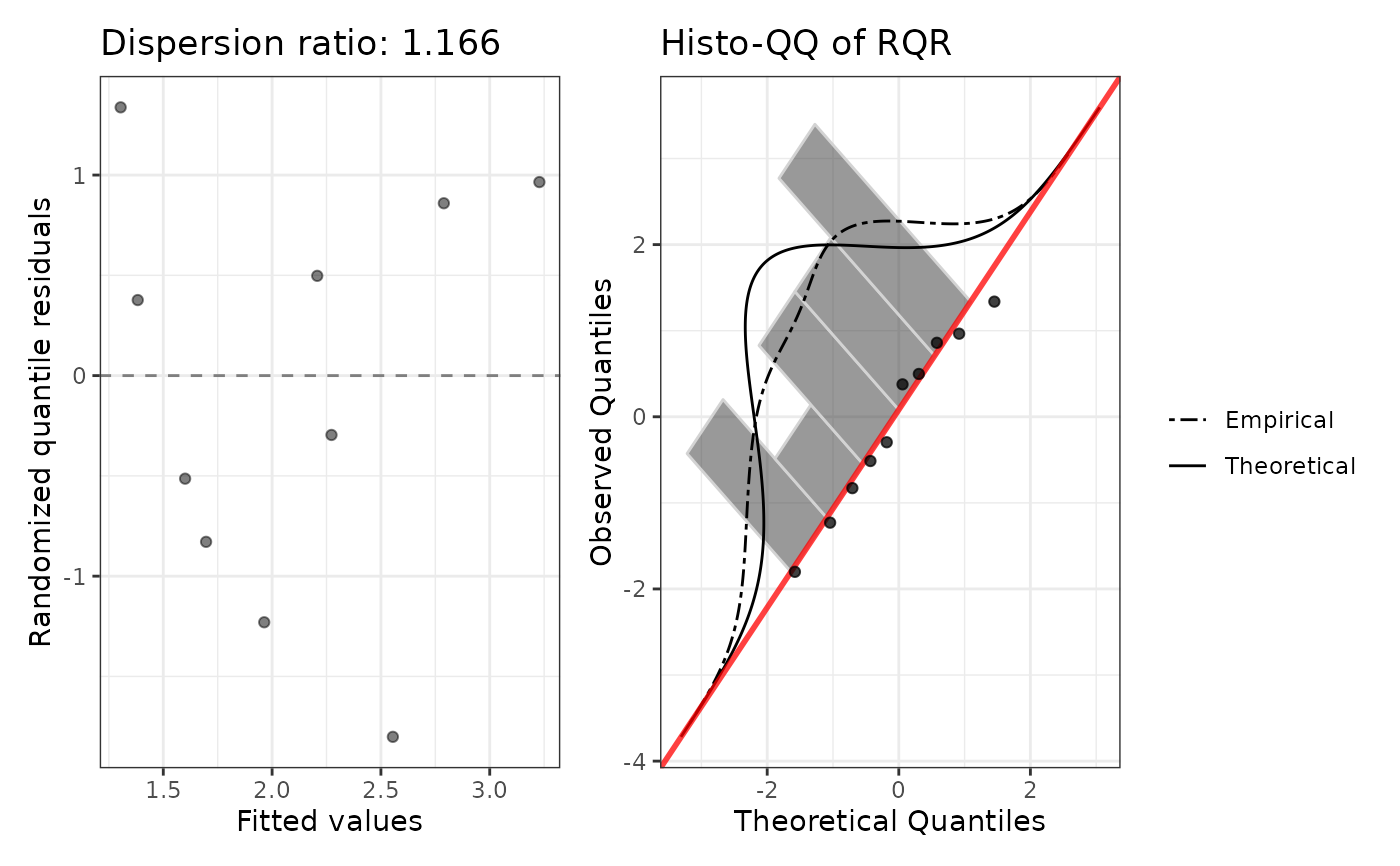
Fits a Poisson GLM and returns model coefficients on the response scale (exponentiated), randomized quantile residuals (RQR), a Pearson dispersion ratio, and diagnostic plots.
Usage
poissonGLM(
  formula,
  data,
  assessZeroInflation = TRUE,
  maxit = NULL,
  dispersion_threshold = 1.2,
  ...
)
Arguments
- formula
A model formula (e.g.
y ~ x1 + x2). The response must be a non-negative integer count variable.- data
A data frame containing the variables in
formula.- assessZeroInflation
Logical; when
TRUE(default), runs a DHARMa simulation-based zero-inflation test after fitting. Issues a warning if significant zero-inflation is detected and addszi_testto the returned diagnostics. Set toFALSEwhen calling fromcountGLM(), which performs its own zero-inflation assessment.- maxit
Optional integer; maximum IWLS iterations passed through as
control = stats::glm.control(maxit = maxit). Ignored when the user supplies their owncontrolvia....- dispersion_threshold
Numeric; dispersion ratios above this value are flagged as overdispersed in the diagnostic plot. Default 1.2.
- ...
Additional arguments passed to
stats::glm().
Value
An object of class c("poissonGLM", "countGLMfit"), a list with:
callThe matched call.
modelThe underlying stats::glm fit object.
summaryThe result of
summary()on the fitted model.coefficientsA data frame with columns
term,exp.coef,lower.95,upper.95(all on the response/exponentiated scale).diagnosticsA list with:
rqrNumeric vector of randomized quantile residuals.
dispersion_ratioPearson chi-squared / df.residual.
plotPatchwork ggplot: fitted vs RQR and histo-QQ.
r2_plotSquared Pearson residuals vs fitted values.
zi_testWhen
assessZeroInflation = TRUE, a list withdetected(logical),p_value(numeric), andplot(ggplot histogram of DHARMa simulated zero proportions vs observed).NULLwhenassessZeroInflation = FALSE.
aicAIC of the fitted model.
bicBIC of the fitted model.
Details
Coefficient interpretation: Poisson regression models the log of the expected count. Exponentiating a coefficient gives the multiplicative change in the expected count for a one-unit increase in the predictor.
Condition checking: Inspect diagnostics$dispersion_ratio (near 1 is
good) and diagnostics$zi_test$p_value for zero-inflation.
Examples
df <- data.frame(
  y  = c(0L, 1L, 2L, 3L, 5L, 0L, 2L, 4L, 1L, 3L),
  x1 = c(1.2, -0.4, 0.8, -1.1, 2.0, 0.3, -0.9, 1.5, -0.2, 0.7)
)
fit <- poissonGLM(y ~ x1, data = df)
#> Warning: Count component: 8 events (y > 0) for 1 predictor(s) (8.0 per predictor). At least 10 events per predictor is recommended.
print(fit)
#>
#> Call:
#> poissonGLM(formula = y ~ x1, data = df)
#>
#> Model family: poissonGLM
#>
#> Coefficients (on response scale):
#>         term exp.coef lower.95 upper.95 p.value stars
#>  (Intercept)   1.7989   1.0683   3.0290  0.0272     *
#>           x1   1.3396   0.8572   2.0936  0.1993
#>
#> Dispersion ratio: 1.1658
#> AIC: 39.02
plot(fit)